
Average Testosterone Levels by Age


The short version:
- The normal range for adult men is roughly 300–1,000 ng/dL of total testosterone.
- Levels peak in your 20s and decline about 1% per year after age 30 — average levels fall from around 680 ng/dL in the 20s to around 420 ng/dL after 70.
- “Low” means below 300 ng/dL, confirmed on two separate morning blood tests, plus symptoms.
- Where you sit within the normal range matters: 300 ng/dL is bottom-of-range for a 20-year-old but close to average territory for a 70-year-old.
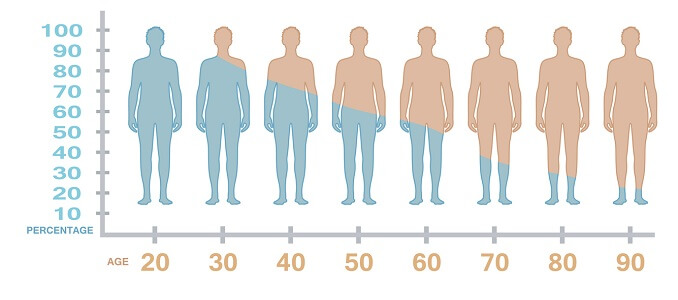
Here’s the direct answer: healthy adult men typically measure between 300 and 1,000 ng/dL of total testosterone, and the number drifts downward with age — highest in the 20s, then falling roughly 1% per year after 30. The chart below shows the average and typical range for each decade of life.
Knowing what’s normal for your age helps you judge whether your level might be lower than it should be — and whether symptoms you’re feeling could be related to testosterone decline. This guide gives you the age-specific ranges, explains what the numbers mean, and shows when testing makes sense.
Testosterone Levels by Age: Chart
Testosterone follows a predictable pattern as men age. Here’s what clinical data shows, decade by decade:
| Age Range | Average Testosterone Level | Typical Range |
|---|---|---|
| 20–29 years | 680 ng/dL | 400–1,000 ng/dL |
| 30–39 years | 650 ng/dL | 380–980 ng/dL |
| 40–49 years | 600 ng/dL | 350–920 ng/dL |
| 50–59 years | 520 ng/dL | 300–850 ng/dL |
| 60–69 years | 470 ng/dL | 270–760 ng/dL |
| 70+ years | 420 ng/dL | 240–650 ng/dL |
Two things stand out. First, the decline is steady, not sudden — about 1% per year after age 30. Second, the averages hide big individual differences: some men keep high levels well into their 70s, while others fall faster. The Cleveland Clinic notes that this age-related decline is normal — the question is whether yours has gone further than aging alone explains.
Whatever your decade, the same clinical bands frame how a result is read. (For how labs define the normal adult range in the first place, see our guide to normal testosterone levels.)
| Below 300 ng/dL Low — meets the AUA threshold |
~300–400 ng/dL Gray zone — symptoms decide |
300–1,000 ng/dL Normal adult-male range |
How Your Result Compares to the Lab Range
Across all adult ages, the standard reference range is 300–1,000 ng/dL (nanograms per deciliter — the unit labs use to measure hormones in blood). Labs vary slightly, but the broad bands look like this:
- Below 300 ng/dL — considered low testosterone
- 300–1,000 ng/dL — the normal, healthy range
- Above 1,000 ng/dL — unusually high (may indicate treatment or another condition worth investigating)
But where you fall within the range matters. A 20-year-old at 300 ng/dL is at the very bottom of normal for his age and may well have symptoms; a 60-year-old at the same level is much closer to his age-appropriate average. That context is exactly what the chart above adds.
The Threshold for Low Testosterone
The American Urological Association (AUA) guideline defines low testosterone as total testosterone below 300 ng/dL, confirmed on two separate morning tests, together with symptoms. The clinical picture has more shading, though:
- Below 300 ng/dL — generally low; treatment may be warranted when symptoms are present
- 300–400 ng/dL — a gray zone; some men have symptoms, some don’t
- Above 400 ng/dL — generally not considered low, though individual sensitivity varies
Your symptoms matter as much as your number. A 50-year-old at 350 ng/dL with low energy, mood changes, and sexual dysfunction may benefit from evaluation even though his level isn’t technically “low” by every definition. For the complete picture of what deficiency is and how it’s diagnosed, see our testosterone deficiency guide.
Free vs. Total Testosterone: A Quick Note
The chart above shows total testosterone — everything in your blood, bound and unbound — because that’s what routine screening measures. Free testosterone is the small unbound fraction (about 1–3%) that’s actually available to your cells, and doctors check it when a total result is borderline.
Free testosterone declines with age too. Typical ranges run roughly 8–25 pg/mL at ages 20–40, 6.5–21 pg/mL at 41–60, and 5–19 pg/mL past 60. For what these numbers mean and when free testosterone changes the diagnosis, read our full guide to free testosterone levels.
Women Run on a Different Scale
Women make testosterone too — in the ovaries and adrenal glands — but at a small fraction of male levels. MedlinePlus gives a typical adult female range of about 15–70 ng/dL, compared with roughly 300–1,000 ng/dL in men, and exact cutoffs vary from lab to lab. Like men’s, women’s levels drift lower with age.
Because the scale is so different, a male chart can’t be used to read a woman’s result. Our guide to testosterone levels in women by age has the female ranges and what symptoms to look for.
Why Testosterone Declines with Age

The decline isn’t one process — it’s several aging changes stacking up:
- Changes in the testes: the cells that produce testosterone become less efficient over time
- Pituitary changes: the gland that signals the testes to produce becomes less responsive
- Rising SHBG: with age, more testosterone gets bound to sex hormone-binding globulin (a carrier protein), leaving less available to your cells
- Reduced testicular volume: the testes shrink slightly with age
- General aging effects: most hormone systems gradually slow down
Some decline is normal aging — but the degree varies dramatically between men, which is why some stay vigorous into their 70s while others feel a significant drop in their 40s. Weight, sleep, medications, and medical conditions all shift the curve, as the Urology Care Foundation outlines in its low-testosterone overview.
When to Get Tested

If your symptoms could plausibly be hormonal, testing is simple and worthwhile. Consider it if you have:
- ✓ Persistent fatigue or low energy
- ✓ Decreased sex drive or erectile dysfunction
- ✓ Mood changes, including depression or lost motivation
- ✓ Difficulty building muscle, or unexplained muscle loss
- ✓ Increased body fat, particularly around the abdomen
- ✓ Brain fog or trouble concentrating
- ✓ Multiple risk factors for low testosterone (obesity, diabetes, metabolic syndrome)
Sound familiar? Our symptoms of low testosterone page goes through each sign in detail.
Testosterone testing is a simple morning blood draw — done early because that’s when levels peak, per MedlinePlus. Results typically come back within a few days.
For the how-to — timing, preparation, why two tests are needed, and how to read your results — see our testosterone testing guide. Or take the two-minute testosterone quiz for men first.
What about women? Women’s testosterone runs far lower and follows its own pattern — see testosterone levels in women for female ranges.
Your first step isn’t treatment — it’s information.
1. Get the data: a comprehensive blood panel plus a physical exam establish where you actually stand — hormones and beyond.
2. Let a doctor read the full picture: testosterone is one number among many. Your physician weighs your complete lab work, health history, and exam findings before deciding whether treatment would genuinely benefit your individual case.
FAQs
What testosterone level is typical for a 40-year-old man?
Around 600 ng/dL on average, with a typical range of 350–920 ng/dL. But “normal” varies a lot between individuals — a 40-year-old at 350 ng/dL who has symptoms may benefit from evaluation even though his number technically sits inside the range.
What is considered very low testosterone?
Levels well below the 300 ng/dL cutoff — for example, under 200 ng/dL — are markedly low and warrant evaluation; below 100 ng/dL, symptoms are almost always noticeable. How concerning a number is also depends on how quickly levels dropped, your age, and your overall health.
Can you have low testosterone in your 20s?
Yes. Testosterone is typically highest in young men, but testicular problems, pituitary dysfunction, obesity, certain medications, or genetic factors can push levels down at any age. A young man with symptoms should be tested regardless of age.
How accurate are at-home testosterone tests?
They give a rough indication at best. Clinical blood tests through a healthcare provider are more reliable and standardized, and home results are easily skewed by time of day and recent activity. If a home test suggests low testosterone, confirm it with professional morning testing.
What time of day should testosterone be tested?
Early morning — roughly 6–8 a.m. — when levels are at their daily peak. Testing later in the day gives lower readings, and tests taken at different times can’t be fairly compared.
Related pages: Low Testosterone (Hypogonadism) | Testosterone Testing | Testosterone Levels in Women
References
- American Urological Association. Evaluation and Management of Testosterone Deficiency: AUA Guideline.
- MedlinePlus, U.S. National Library of Medicine. Testosterone Levels Test.
- Cleveland Clinic. Low Testosterone (Male Hypogonadism).
- Urology Care Foundation. Low Testosterone.
- Bhasin S, et al. Testosterone Therapy in Men with Hypogonadism: An Endocrine Society Clinical Practice Guideline. J Clin Endocrinol Metab. 2018.
Medical Disclaimer: The information on this page is for educational purposes only and is not intended as medical advice, diagnosis, or treatment. Always consult a qualified healthcare provider before starting, stopping, or changing any hormone therapy or medication. Individual results vary, and treatment decisions should be made between you and your doctor based on your specific medical history and needs.
 National HRT Staff
Please note that the information provided in this article is for informational purposes only and is not intended as a substitute for professional medical advice, diagnosis, or treatment. Always seek the advice of your physician or other qualified healthcare provider with any questions you may have regarding a medical condition or treatment.
- MedicalNewsToday
- Harvard Medical School
- Feldman HA, Longcope C, Derby CA, et al. Age trends in the level of serum testosterone and other hormones in middle-aged men: longitudinal results from the Massachusetts male aging study. J Clin Endocrinol Metab 2002;87(2):589-98.
- ack G, Zeitlin SI. The role of routine serum testosterone testing: routine hormone analysis is not indicated as an initial screening test in the evaluation of erectile dysfunction. Rev Urol 2004;6(4):203-6.
- Brambilla DJ, O’Donnell AB, Matsumoto AM, McKinlay J. Intraindividual variation in levels of serum testosterone and other reproductive and adrenal hormones in men. Clin Endocrinol (Oxf) 2007;67(6):853-62.
- Men`sHealth