
Testosterone Levels in Men by Age

It is a fact that testosterone levels in men fall as they age, often at the point in life when a man most needs to maintain a steady supply of this vital hormone. This decline typically occurs at some time after a male turns thirty, with a continued decrease of about 1 to 2 percent each year that follows.

Although such a slight reduction in the secretion of testosterone probably does not seem like much at this point, after ten years of a 2% drop every twelve months, a man could find that his production of testosterone is down 20 percent. Now that can make a tremendous adverse impact on his overall well-being quality of life.
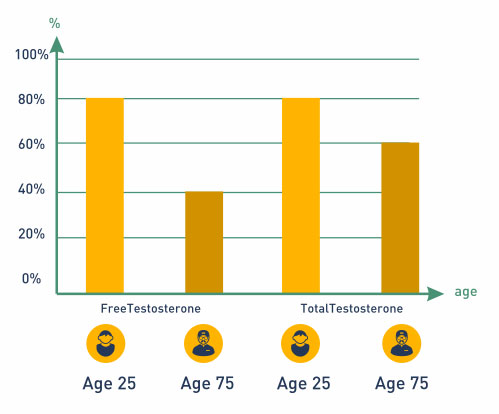
Free testosterone – that which is not bound in the bloodstream to SHBG (sex hormone-binding globulin) – levels have been shown to decline faster than total testosterone. A comparison of testosterone levels for males in the chart to the right displays a decrease of about 30% of total testosterone in healthy men between 25 and 75 years of age compared to 50% for free testosterone.
What Are Normal Testosterone Levels in Men
There is some general disagreement in the medical community as to what constitutes “normal” testosterone levels for men. Although there is no clear definitive answer on a specific number, and the ranges used by various labs can vary significantly, it is widely accepted that total testosterone readings from blood tests that fall between 300 ng/dL and 1050 ng/dL (nanograms per deciliter) are to be considered normal.
That does not mean that a person with a test result of 300 ng/dL is not dealing with Low T. There are many other factors to take into consideration when a doctor is making this determination. That is why it is imperative to seek out treatment from a hormone replacement specialist who will do more than just look at a number, but will, instead, assess the entire individual.
Maintaining optimal testosterone levels in men is crucial for the body to carry out the many functions that this essential hormone is used for. Energy, sexual ability, muscle tone, bone density, cognitive functions, metabolism, hair growth, and mood are all dependent upon a proper amount of testosterone circulating in the body.
Average Testosterone Levels in Men by Age
The biggest concern that doctors specializing in hormone replacement often have is that men who are considered to be on the lower end of what is held as “normal” are actually dealing with the possible debilitating effects of Low T but are not properly diagnosed and prescribed medication to correct this testosterone deficiency.
This is where a specialist will do more than look at a number in a testosterone blood test result, although that is a crucial part of the diagnosis and determination of medication dosage to prescribe. Information gleaned from a physical examination, as well as current symptomology along with the severity of the issues that are present will all go into the equation when a diagnosis and treatment plan are devised.
What are normal testosterone levels in men at the various stages of one’s life?
The information below will help to break it down further:
- Testosterone levels in men over 30:
Free: 8.7 – 25.1 pg/mL (picogram/milliliter)
Total: 219 – 1009 ng/dL Normal 600 – 675 ng/dL
- Testosterone levels in men over 40
Free: 6.8 – 21.5 pg/mL
Total: 201 – 993 ng/dL Normal 500 – 550 ng/dL
- Testosterone levels in men over 50
Free: 7.2 – 24.0 pg/mL
Total: 170 – 918 ng/dL Normal 400 – 450 ng/dL
- Testosterone levels in men 60 and over
Free: 6.6 – 18.1 pg/mL
Total: 156 – 700 ng/dL Normal 300 – 350 ng/dL
It is clear that the variance shown can make a big impact on how a man feels, thinks, and looks based on where his numbers will be found. The average testosterone levels in men by age listed here are basic guidelines that hormone specialists will use to assess each male on an individualized basis.
Some studies have shown that men over sixty are often found to have total testosterone levels under 241, which could explain the many changes they are experiencing.
Testosterone Levels in Men Chart
There is a tremendous benefit for men who are experiencing symptoms of fatigue, muscle loss, joint pains, stiffness, hair loss, low libido, erectile dysfunction, mental fog, depression, or memory loss to contact National HRT® to discuss the possibility of getting a blood test for Low T. These are all possible signs that testosterone levels are below what is needed by the body for optimum functioning.
Take a look at the normal testosterone levels in men by age chart below as a reference:
| Age Years | Free Testosterone Average Range | Total Testosterone Average Range | Normal Total Testosterone |
| 30 – 40 | 8.7 – 25.1 pg/mL | 219 – 1009 ng/dL | 600 – 675 ng/dL |
| 40 – 50 | 6.8 – 21.5 pg/mL | 201 – 993 ng/dL | 500 – 550 ng/dL |
| 50 – 60 | 7.2 – 24.0 pg/mL | 170 – 918 ng/dL | 400 – 450 ng/dL |
| Over 60 | 6.6 – 18.1 pg/mL | 156 – 700 ng/dL | 300 – 350 ng/dL |
What is considered normal testosterone levels in men by age varies considerably, as shown above. A man in his early fifties who falls at the low end of the average range will most likely be experiencing many of the symptoms associated with Low T. Treatment with bioidentical testosterone therapy will be beneficial at this point.
The professional staff at National HRT® is here to answer any questions dealing with Low T or any other type of hormonal deficiency. We offer testing, support, and treatment for men, as well as women, dealing with decreasing hormone levels.
Frequently Asked Questions
What is the average testosterone level by age for men?
Testosterone levels peak in late adolescence and early adulthood, usually between ages 18 and 25, with average total testosterone ranging from 600 to 900 ng/dL. After age 30, levels decline naturally by about 1% per year. Men in their 40s may average 500–700 ng/dL, and by their 60s, levels often fall closer to 400 ng/dL or lower. Routine blood testing can help monitor whether your testosterone level is within a healthy range for your age.
What causes testosterone levels to drop with age?
A gradual decline in testosterone is a natural part of aging as testicular and pituitary function slow. However, lifestyle factors such as obesity, poor sleep, high stress, alcohol use, and certain medications can make this decline happen faster. Chronic conditions like diabetes or thyroid disorders can also contribute to low testosterone in older men.
What are the symptoms of low testosterone in middle-aged men?
Symptoms of low testosterone often appear after age 40 and include fatigue, decreased muscle mass, weight gain, erectile dysfunction, low libido, irritability, and reduced focus or motivation. These symptoms can overlap with normal aging, so a blood test is the most accurate way to confirm if testosterone levels are low.
Can testosterone replacement therapy help men over 40?
Yes, testosterone replacement therapy (TRT) can effectively restore healthy hormone levels for men with clinically diagnosed low testosterone. When managed by a licensed medical provider, TRT can improve energy, muscle strength, libido, mood, and cognitive clarity. Regular monitoring ensures treatment safety and effectiveness.
How can men naturally maintain healthy testosterone levels as they age?
Men can support testosterone production naturally by exercising regularly (especially weight training), getting adequate sleep, maintaining a healthy weight, managing stress, and eating a nutrient-rich diet. Vitamins and minerals like zinc, magnesium, and vitamin D also play an important role. However, men with clinically low levels should seek medical evaluation for proper treatment options.
 National HRT Staff
Please note that the information provided in this article is for informational purposes only and is not intended as a substitute for professional medical advice, diagnosis, or treatment. Always seek the advice of your physician or other qualified healthcare provider with any questions you may have regarding a medical condition or treatment.